
Our story begins in a small, remote village in Mexico in 1975. A midwife wraps a baby girl, born mere minutes ago, in a blanket. She pins the blanket at the neck to keep the child warm. The midwife gets the child to sleep and leaves her to rest.
Later, the mother returns, removes the blanket, and discovers a horrid mistake: the midwife had clipped the safety pin through a small piece of skin in the child’s neck.
And thus begins the trial of Angelica, the baby girl with a pinprick in her neck.
Angelica’s wound never healed; it lingered. A pin-sized opening that oozed mucus daily, staining collars during the day and soaking pillows at night. Doctors brushed it off; it was nothing serious, nothing to worry about as long as she kept it clean. “I never thought it could be anything else,” Angelica recalled. “I was just told, this is how it is.”
That small mark became the shadow over her childhood. By third grade, the constant drainage forced her out of school. Embarrassment kept her wrapped in turtlenecks, hiding from strangers’ stares.
For so many years, I believed what I had been told. It was hard to think it could be fixed."
Angelica learned to cope by retreating inward. She socialized only with her siblings and wore high collars around anyone else. Work opportunities slipped away – she once left a secure job when new uniforms exposed her condition to co-workers’ eyes. “After that, I never looked for jobs again,” she said. “People would judge me.”
For decades, she sought no further medical care. “I thought everyone would just tell me the same thing,” she explained. As she neared fifty and the pain began to worsen, she tried again, this time through the Sierra Sacramento Valley Medical Society’s SPIRIT program, which provides specialty care to uninsured and underserved patients.
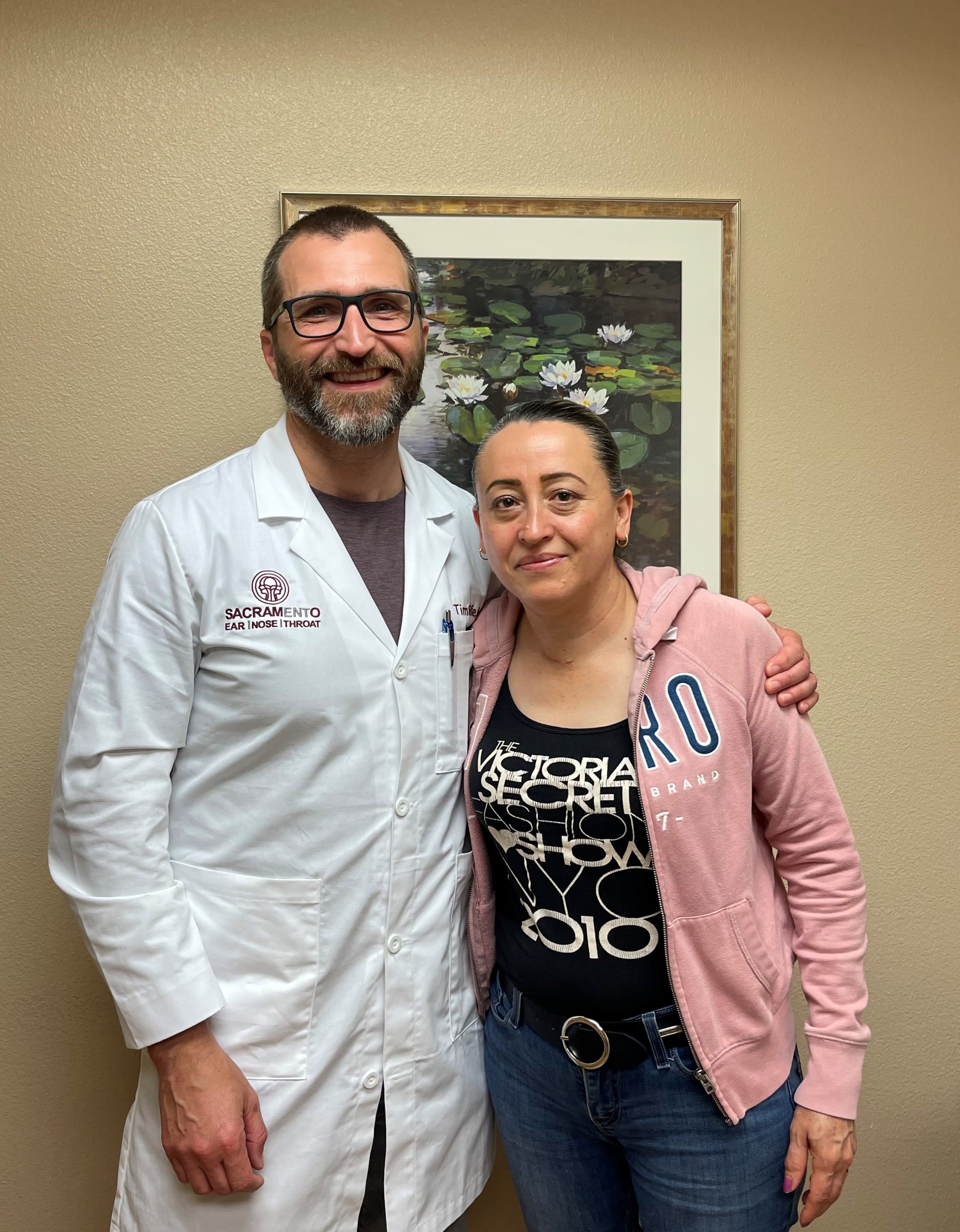
Her case landed on the desk of Tim Fife, MD, an ear, nose, and throat surgeon who volunteers with SPIRIT. At first, the referral described a thyroglossal duct cyst – a condition usually seen in children. But as he sifted through records, the description didn’t match. Imaging reports mentioned a thrombosed jugular vein, only adding to the puzzle.
“When I read it, I thought, something’s not adding up,” Dr. Fife said. “I needed to see her myself.”
When Angelica shared her story – a “safety pin” wound that drained every day of her life – clarity dawned. Dr. Fife ran some tests and shared the news with Angelica. The midwife story was cute, he said, but whatever pinprick she received was merely coincidental and wasn’t the cause of her situation. She wasn’t living with a cyst at all, but with a branchial cleft fistula, a congenital defect formed in the womb.
“In embryology, the tissues of the throat and neck fold and fuse in specific ways,” Dr. Fife explained. “Sometimes a tract doesn’t fully dissolve, leaving a narrow tube that can drain for life. In her case, it stretched the entire length of her neck, from the base up into her throat near her tonsil. To see this in someone in their fifties – it’s almost unheard of.”
Branchial cleft anomalies occur in roughly one in 100,000 births. Fistulas are rarer still. Most are discovered and surgically corrected in childhood. For Angelica to reach her fifties without infection or intervention, Dr. Fife said, made her “a true unicorn.”
Angelica was overwhelmed at first. “For so many years, I believed what I had been told,” she said. “It was hard to think it could be fixed.”
Surgery was her only option that could fix it. Dr. Fife reassured her that the condition wasn’t life-threatening but warned that infection was a risk. She hesitated, then chose to proceed. “I told myself, I’ve waited fifty years. Now that I have the chance, I have to do it.”
For Dr. Fife, the case was both rare and rewarding. “I’d be lying if I said there wasn’t a part of me as a surgeon that wanted to take this on,” he admitted. “But ultimately, it was her decision. What mattered was that she trusted me enough to say yes.”

The surgery demanded care. The fistula tract extended nearly seven inches, weaving between carotid arteries and under cranial nerves vital for tongue movement. To minimize scarring, Dr. Fife used a “stair-step” approach: two small incisions instead of one long one, tunneling carefully to remove the tract in sections.
“All the nurses and scrub techs were geeking out,” he recalled. “It was such an unusual case. And everything went smoothly.”
From Angelica’s perspective, the change was immediate. “After surgery, I feel like I’m 20 again,” she said. “It’s like a second chance at life.”
She began working at a school, surrounded by children. “As a girl, I dreamed of being a teacher. Maybe it’s too late for that, but now I can be around kids every day. They all like me, and I’m so happy.”
Her family, always supportive, is thrilled to see her thriving. “I tell others: don’t wait like I did. Keep looking until you find an answer.”
After surgery, Angelica gifted him a small cactus, which now sits on his desk. "Every day I see it and think of her. It’s a reminder of how meaningful this work can be."
To Dr. Fife, Angelica’s case reaffirmed the essence of medicine. “So much of our work today is tied up in billing, authorizations, and regulations. It can make doctors feel jaded,” he said. “But with SPIRIT, all of that falls away. No insurance battles, no paperwork fights. Just a patient who needs help, and a team willing to provide it. That’s the pure form of doctoring I imagined when I started.”
The gratitude he received was unforgettable. After surgery, Angelica gifted him a small cactus, which now sits on his desk. “Every day I see it and think of her. It’s a reminder of how meaningful this work can be.”
Both patient and surgeon emphasize the importance of the SPIRIT program. For Angelica, it was the only path to care she could not afford. For Dr. Fife, it provided a framework to contribute as a specialist.
“The program made it easy,” he said. “They handled logistics, coordinated with the surgery center, and let me focus on care. For any physician thinking about volunteering, it’s a chance to experience medicine at its most rewarding.”
Angelica spent fifty years believing her condition was untreatable. Today, she wakes without pain, works among children she adores, and no longer hides behind turtlenecks.
Her message is simple: “Don’t lose faith. You will find someone who can help.”
And for Dr. Fife, the case reaffirmed his purpose. “This is why we do what we do,” he said. “To give someone their life back.”
***
Cover photo by Marco Antonio Casique Reyes, courtesy Pexels
Brandon J. Craig
bcraig@ssvms.org
Brandon J. Craig is communication and partnerships manager at SSVMS.
- Previous
- ← The Other Epidemic
- Next
- Pho Momma →